Radiant warmth underfoot, without a drop of water in the floor
- ■Heat transferRefrigerant-direct (DX), no water in floor
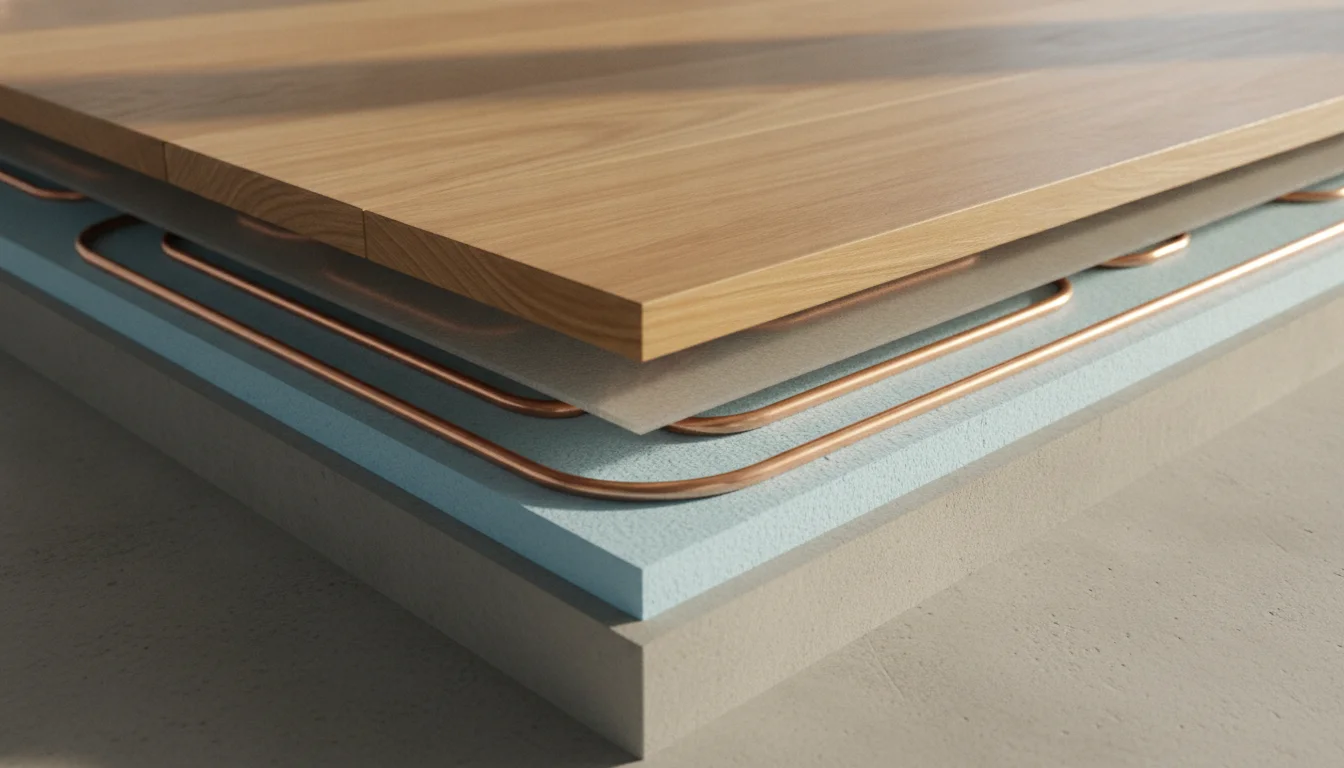
- ■Floor build-upAbout 1 to 2 inches
- ■EfficiencyCOP up to 4.6
- ■Cold-climate ratingRated to minus 13 degrees Fahrenheit
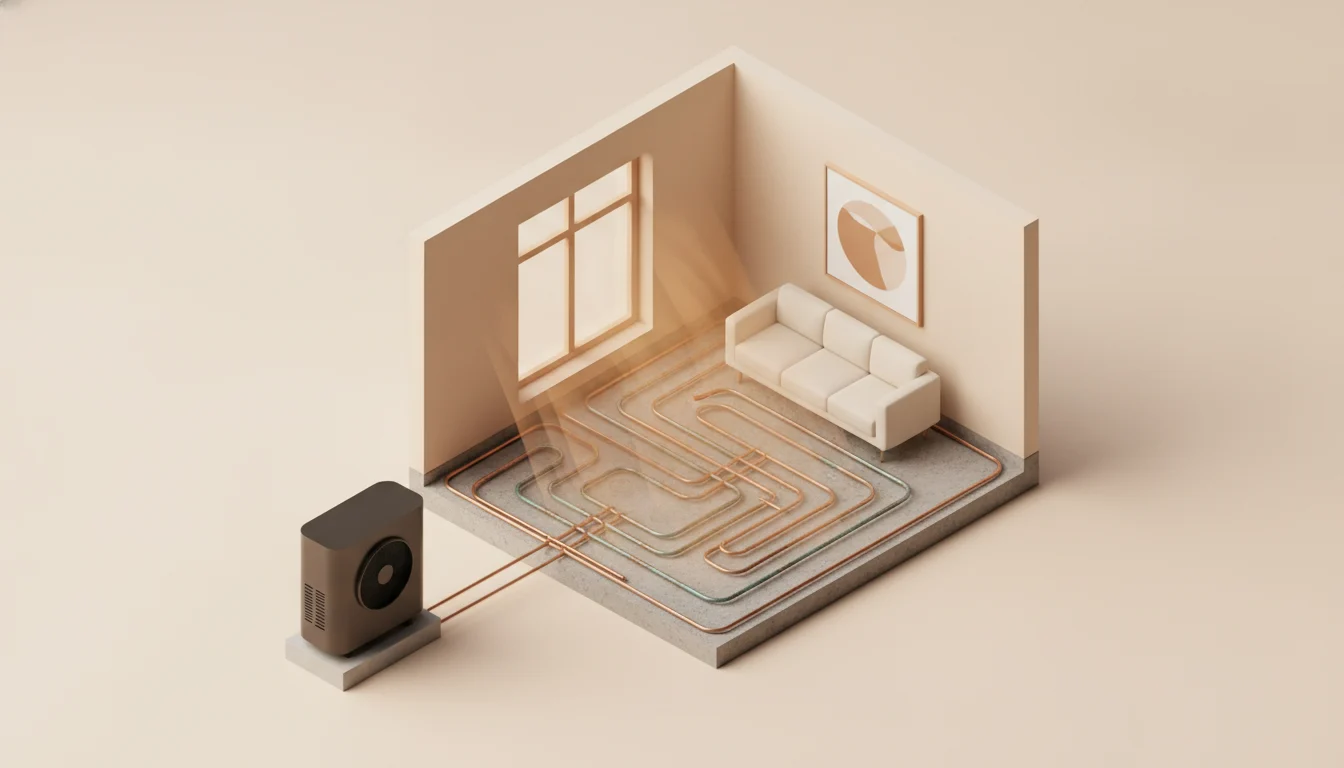
Waterless radiant floor heating gives you the quiet, even warmth of a heated floor with none of the water risk that traditional hydronic systems carry. Instead of pumping heated water through the floor, our system sends refrigerant directly through a weld-free copper loop network embedded just beneath the surface, so the floor itself becomes a gentle radiant emitter. There is no boiler, no buffer tank, no circulating pump, and no antifreeze. And because there is no water in the floor, there is nothing to leak, scale, or freeze and burst. The result is the comfort affluent homeowners want, heat that rises evenly from the floor with no drafts, no forced-air noise, and warmth from the moment you step out of the shower, paired with the efficiency of a modern air-source heat pump. It is radiant comfort, purpose-built for your quality life.
What Sets Our Waterless Radiant Floor Heating Apart
No water in the floor, ever
Refrigerant flows directly through the embedded copper loops, not water. With no water under your floors, there is nothing to leak into the slab, build up scale, or freeze and burst in a cold snap, removing the single biggest worry homeowners have about hydronic radiant.
Weld-free copper, built to stay sealed
The floor loop is a corrosion-resistant copper capillary network with a weld-free construction, pressure-tested and verified gas-tight before the floor is ever closed. It is the part you can never see, engineered so you never have to think about it.
Even, draft-free warmth from the floor up
Heat radiates evenly across the whole floor rather than blowing from vents, so there are no cold corners, no forced-air drafts, and no circulated dust. The floor is comfortable underfoot from morning to night, the way radiant comfort should feel.
Air-source heat-pump efficient, with a thin profile
A single inverter air-source heat pump powers the system with a COP up to 4.6 and reliable performance rated down to minus 13 degrees Fahrenheit. The copper loop adds only about 1 to 2 inches of floor build-up, so it fits cleanly into new builds and major renovations.
Quiet, zoned, and low-maintenance
With no circulating pump and no water loop, the system runs quietly and frees you from antifreeze, water-quality, and scaling upkeep. Rooms can be controlled independently, so bedrooms, living areas, and baths each hold the temperature you prefer.
Technical Specifications
- Anti-corrosion-treated copper capillary tubing
- Weld-free brazed joints
- Thin-slab radiant build-up
- ■New custom homes where the copper loop can be embedded cleanly before the floor is finished
- ■Major renovations and high-end remodels seeking invisible, draft-free comfort
- ■Cold-climate residences where water-loop freezing is a real concern
- ■Whole-home or per-room zoned heating across living spaces, bedrooms, and baths

Proven across 690,000 square feet of real-world installations
Challenge
Homeowners want the comfort of radiant floors but fear the classic hydronic failures, water leaking into the slab, scale building up, and pipes freezing and bursting in winter. Solving this meant delivering radiant warmth with no water in the floor at all, while keeping the system efficient, quiet, and serviceable.
Solution
The waterless DX system replaces the water loop with refrigerant sent directly through a weld-free, corrosion-resistant copper capillary network embedded just beneath the floor. Every loop is pressure-tested and verified gas-tight before the floor is closed, and a single inverter air-source heat pump drives the whole system with only about 1 to 2 inches of floor build-up.
Result
The approach has been deployed across roughly 690,000 square feet of homes, residences, and larger buildings, demonstrating that refrigerant-direct radiant can serve as dependable primary heat while removing the water-loop leak, scale, and freeze risks of traditional hydronic radiant.
Frequently Asked Questions
Waterless radiant floor heating warms your home through the floor, like traditional radiant, but uses refrigerant instead of water. An air-source heat pump sends refrigerant directly through copper capillary coils embedded under the floor, turning the floor into a gentle radiant surface. There is no boiler, buffer tank, circulating pump, or antifreeze, and no water in the floor at all.
Traditional hydronic radiant can, because it circulates water that may leak, scale, or freeze and burst. Our waterless system has no water in the floor, so those specific risks are removed. The copper loop is weld-free, corrosion-resistant, and pressure-tested gas-tight before the floor is closed. No system is risk-free, but the water-loop failure modes simply do not exist here.
Hydronic radiant runs heated water from a boiler through PEX tubing using a circulating pump. Our system removes the water step entirely: an air-source heat pump sends refrigerant straight into the copper floor loops. That means no boiler, no buffer tank, no pump, and no antifreeze, fewer parts to maintain, and none of the leak, scale, or freeze risk that comes with a water loop.
For homeowners who value comfort and reliability, it delivers the even, draft-free warmth radiant is loved for while removing the water risk that makes people hesitate. It pairs that comfort with air-source heat-pump efficiency, a COP up to 4.6, and quiet, low-maintenance operation. Radiant heating is also a recognized luxury feature that buyers actively seek when a home is sold.
Yes. The system is rated to perform down to minus 13 degrees Fahrenheit, and because there is no water in the floor, there is no antifreeze to manage and no risk of pipes freezing and bursting during a deep cold snap. The air-source heat pump maintains efficient radiant heat through the coldest months, making it well suited to northern homes.
Waterless DX uses refrigerant in copper capillaries with a COP of 3.5–4.5, while hydronic uses water at 80–95% efficiency. Waterless DX requires zero scheduled maintenance and lasts 50+ years, whereas hydronic needs annual glycol checks and pump replacement every 10–15 years. For whole-home systems over 1,000 sq ft, waterless DX offers lower lifetime cost.
Yes, when paired with renewable energy. Waterless DX systems achieve a COP of 3.5–4.5, meaning 1 kWh of electricity produces 3.5–4.5 kWh of heat. This makes them the most efficient all-electric option. Electric resistance systems have COP of 1.0, while hydronic typically burns fossil fuels on-site.
Zoned heating controls typically pay for themselves within 1–2 years through 20–30% energy savings. For a waterless DX system in a 1,400 sq ft home, the payback period versus electric is 2–3 years of operation.
Air-source heat pumps achieve a COP of 3.0–4.0, producing 10,236 BTUs per kWh, three times more than electric resistance. For a 1,400 sq ft home, waterless DX costs $100–170 per month versus $300–500 for electric, significantly lowering long-term expenses.
Hydronic systems can reduce energy bills by 15–30% compared to forced air, but the circulating pump adds 300–800 kWh/year. Pairing with an air-source heat pump yields a COP of 2.8–3.5, while waterless DX achieves 3.5–4.5, lowering annual costs further.
Electric mats have lower upfront cost but higher operating cost. For a typical 500 sq ft area, hydronic becomes cheaper after 5–7 years depending on local electricity rates. Waterless DX has a higher upfront cost but lower lifetime cost due to higher COP and no pump maintenance.
Electric heating mats typically last 20-25 years, compared to 35-50 years for waterless DX or hydronic systems. Proper installation with a self-leveling compound and avoiding thick floor coverings can maximize lifespan. The heating cable itself is durable, but the thermostat may need replacement sooner.
Electric floor heating is ideal under tile and stone, which have R-values below 2.0. Hardwood and engineered wood are limited; the R-value must be below 2.0 to avoid overheating. Carpet and thick vinyl are not recommended as they can reduce efficiency by up to 30% and damage the mat.
For a large room over 500 square feet, specify multiple zones with separate thermostats to avoid overloading circuits. Choose loose cables for irregular shapes or pre-spaced mats for rectangular layouts. Ensure the subfloor has R-5 to R-10 insulation. Consider a smart thermostat like Warmup's 6iE to schedule heating and reduce energy use by 15–30%.
Yes, a smart heating app can reduce energy consumption by 15–30% according to manufacturer data. Smart thermostats like Nuheat's Signature or Schluter's DITRA-HEAT Wi-Fi allow scheduling, remote control, and energy monitoring. For example, you can warm the bathroom floor for morning use and let it cool during the day, cutting bills by about 20% with a payback period of 2–3 years.
Radiant floor heating can increase resale value by 3-5% in cold climates, according to real estate studies. Buyers perceive it as a premium feature that offers comfort and energy efficiency. However, the system must be properly installed and documented to add value; poorly designed systems can be a liability.
Waterless DX systems integrate directly with cold-climate air-source heat pumps using enhanced vapor injection, allowing operation below 0°F. Hydronic systems require a buffer tank and may need auxiliary heat. Electric systems work with any air-source heat pump but are less efficient. Proper sizing and controls are critical for optimal performance.
Installed cost ranges from $8 to $15 per sq ft, including mat, thermostat, sensor, and labor. Operating cost runs $0.10–$0.20 per sq ft per month in cold climates. For a 300 sq ft bathroom, annual energy cost is $360–$720.
Yes, but laminate must be rated for radiant heat (max surface temp 82°F). Use a low-wattage mat (10–12 W/sq ft) and a floor sensor to prevent overheating. Check manufacturer guidelines; some laminates void warranty if used with radiant heat.
Electric systems cost $8–12 per sqft installed but have 2–3 times higher operating costs per BTU than hydronic. Hydronic costs $15–20 per sqft but lasts 30–50 years vs 15–25 for electric. For slabs over 500 sqft, hydronic is more economical long-term.
Explore More Capabilities
Heat, Cool & Hot Water — One System
Most luxury homes end up with two mechanical systems fighting for space, budget, and attention: radiant or hydronic heat for winter, and a separate air-conditioning system bolted on for summer. Waterless Radiant settles the question. A single inverter air-source heat pump drives refrigerant directly through copper capillary coils in your floor for invisible, draft-free warmth all winter — then, in summer, the same platform delivers cooling through discreet, ultra-quiet indoor air handlers. Add domestic hot water and one system handles all three. There is no second condenser to hide outside, no competing thermostats, no mismatched comfort. You design once, install once, and own one coordinated system that holds the whole house steady year-round — purpose-built for the way you actually live in your home.
Learn more →Durability & ServiceabilityAnti-Corrosion Copper Capillary System
The deepest fear of any homeowner considering in-floor heating is simple: what happens if it fails and the floor has to come up? We engineered the answer into the system itself. Our radiant network is built from anti-corrosion-treated copper capillary tubing, joined with weld-free, air-tight connections, and fully embedded so it works silently for the life of your home. The copper is corrosion-protected specifically to resist the aggressive concrete chemistries that caused failures in early in-floor systems decades ago, then validated through salt-spray, corrosion, and long-term pressure testing. Just as important, it is designed to be serviced, not demolished. Each loop is isolated by its own valve, and our three-step leak-location method pinpoints any issue to within a small area before a single tile is touched. The result is a heating and cooling foundation purpose-built to outlast the floor above it.
Learn more →Industries Using Waterless Radiant Floor Heating
Ready to Get Started with Waterless Radiant Floor Heating?
Tell us about your project requirements and get a custom quote within 24 hours. No minimums on digital production — start with a prototype and scale to millions.