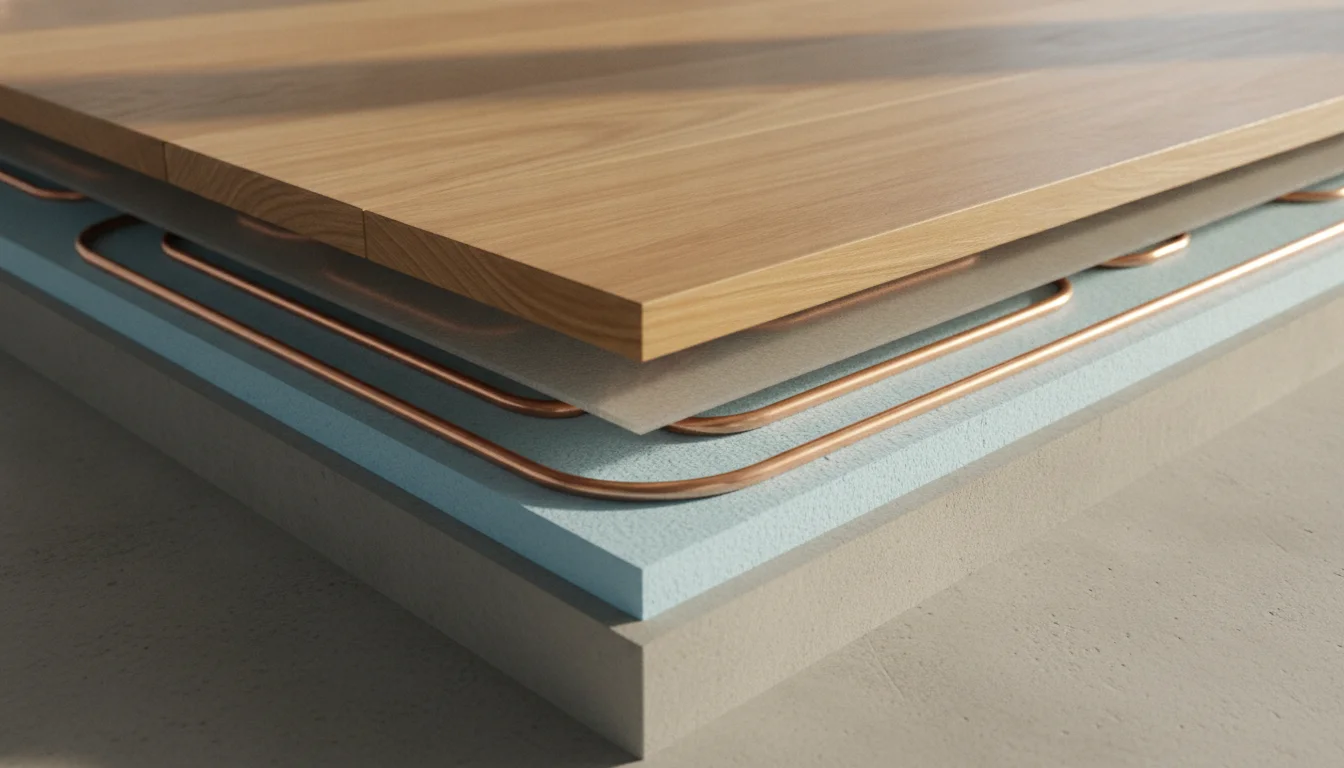
Most radiant heat failures trace back to the water side. Here are the common problems, why they happen, and which ones a waterless DX system removes.
The short answer: The large majority of radiant floor heating problems homeowners report do not come from the floor itself. They come from the water side of the system, the loop of pipes, pumps, valves, and fluid that traditional hydronic radiant depends on. Leaks, air locks, scale, glycol breakdown, and pump or manifold failures are all water-side problems. A waterless direct-expansion (DX) radiant system carries refrigerant instead of water through the floor, which removes that entire category of failure. What it does not remove is the need for a correct, well-commissioned installation, because no heating system is immune to a bad start. The same is true of electric-resistance radiant, whose biggest drawback is not breakdowns but the cost of running it.
Below is a plain-English, problem-by-problem tour. For each issue you will find the symptom you would actually notice, the underlying cause, whether a waterless DX design avoids it, and what to do about it. Where this article mentions cost or lifespan ranges, those are figures typically reported by homeowners and service trades rather than guaranteed numbers, because every home and install is different.
Cold spots and uneven heat
Symptom: One room or one part of a room stays cold while the rest of the floor is warm, or the whole floor feels lukewarm and never quite gets there.
Cause: In a hydronic system the floor only stays warm if heated water keeps moving through every loop. Anything that interrupts that flow, an air bubble, a stuck zone valve, an unbalanced manifold, or a tired circulator pump, shows up as a cold patch. Loops that were run too long during install also lose temperature toward their far end, leaving a predictable cool zone. And the single most common cause of an apparent total failure is actually a faulty or mis-programmed thermostat, which can mimic a dead system even when the equipment is fine.
Can waterless DX avoid it? Largely, yes. A waterless system warms the floor by circulating refrigerant directly, so there is no water to stall and no loop to air-bind. The flow-blockage failures that create cold spots in water systems are designed out. You still rely on a thermostat and zoning controls, so a control fault or an under-designed layout can still leave a room cooler than you want.
What to do: Rule out the thermostat first, then check zoning settings. With hydronic, an unbalanced manifold or air in a loop is the next suspect and is a routine service fix. With any system, uneven heat that was there from day one usually points to design rather than failure, which is why loop layout deserves attention before the floor is poured.
In-slab leaks
Symptom: A drop in system pressure, an unexplained rise in water use, a warm or damp patch on the floor, or in the worst case visible water damage. A buried leak can go unnoticed for a long time.
Cause: In water-based systems, leaks typically start at joints and fittings, at points where the tubing was nicked during the pour, or where years of pressure and temperature cycling finally find a weak spot. Once water escapes inside or under a slab, locating and repairing it can mean an expensive, destructive floor opening.
Can waterless DX avoid it? This is where the difference is most dramatic. A waterless DX floor carries no water at all, so there is no pressurized water loop in the slab to spring a pinhole leak and no fluid to soak into your subfloor. The embedded network is built from corrosion-protected copper capillary tubing with weld-free, air-tight joints, which removes the heat-affected welds where pinhole leaks usually begin. To be honest about it, any sealed refrigerant circuit must still be installed and pressure-verified correctly, and that is exactly why commissioning matters. But the everyday scenario of a buried water leak ruining a floor simply does not exist when there is no water in the floor.
What to do: For an existing hydronic floor, watch system pressure and act early; a slow pressure loss is the cheapest time to find a leak. For a new build, the choice of joint type and a documented pressure test before the floor is closed are the most important defenses.
Air locks
Symptom: Gurgling or trickling sounds, a floor that is warm in some rooms and stone-cold in others, or heat that quits even though the boiler is running.
Cause: An air lock is trapped air inside a water loop that acts like a cork, stopping heated water from circulating past it. It is one of the most common hydronic service calls. Persistent air problems often signal a deeper issue, such as a small leak quietly drawing air into the system.
Can waterless DX avoid it? Yes, completely. Air locks are purely a water-loop phenomenon. A waterless DX system has no water-filled loops to trap air, so this entire failure mode goes away. There is nothing to bleed and no seasonal purging routine for the in-floor portion.
What to do: On a hydronic system, bleeding the loops purges the air and usually restores flow. If air keeps coming back, have the system checked for a leak rather than re-bleeding it every season.
Glycol breakdown, scale, and corrosion
Symptom: Gradually falling efficiency, longer run times, and parts that fail sooner than expected. The decline is slow, so it is easy to miss until a pump or valve gives out.
Cause: The fluid inside a hydronic system degrades over time. Many systems use a glycol antifreeze mix that breaks down over the years, turning acidic and losing its protective qualities, which means it has to be tested and eventually replaced. In systems running plain water, dissolved minerals form scale that narrows pipes and coats heat-exchange surfaces, while oxygen in the water can corrode metal components from the inside.
Can waterless DX avoid it? Yes for the fluid-related failures. There is no glycol to break down, no mineral-laden water to scale up, and no oxygenated fluid sitting against metal year-round. The honest caveat is corrosion of the buried tubing itself, a real failure mode in some early in-slab systems decades ago. We address that directly with copper that carries a dedicated anti-corrosion treatment formulated for life inside concrete, then validated through salt-spray and corrosion testing, rather than relying on the bare metal alone.
What to do: Owners of hydronic systems should keep to a fluid-testing schedule and replace glycol when it tests acidic. For new installs, in-slab durability comes down to the tubing and its corrosion protection.
Circulator pump and manifold failures
Symptom: Part or all of the floor goes cold suddenly, sometimes with a humming or silent pump, or a zone that no longer responds to the thermostat.
Cause: A hydronic system is only as reliable as the mechanical parts that move and direct the water. Circulator pumps wear out and eventually fail, zone valves stick or break, and manifolds with their actuators and flow meters add more components that can drift out of balance or quit. Each is a moving or actuated part with a finite service life.
Can waterless DX avoid it? The in-floor failures, yes. Because a waterless system does not pump water through the slab, it removes the in-floor pumps, zone valves, and wet-side manifold hardware that drive a large share of hydronic service calls. The embedded network has no moving parts underfoot, so there is nothing in the floor to wear out. The system still has an outdoor heat-pump unit and controls that, like any heat pump, need periodic professional checks.
What to do: On a hydronic system, a failed circulator or zone valve is a standard, if inconvenient, replacement. With waterless, the equivalent care moves outdoors to the heat pump and away from the floor you cannot easily reach.
Slow response and temperature lag
Symptom: The floor takes hours to warm up and stays warm long after the thermostat is satisfied, making it hard to dial in comfort or respond to a sudden change in weather.
Cause: Traditional hydronic systems carry a lot of thermal mass: the water in the loops plus the slab itself all have to be heated before you feel a difference. Response time also depends heavily on system design and how the controls are set to run.
Can waterless DX avoid it? Partly. A waterless DX system removes the thermal mass of the water itself, since refrigerant changes temperature far faster than a slab full of heated water, which can help tighten response. It is not instant, because the slab still has mass, but eliminating the water-loop lag is a meaningful improvement, and smart zoning lets you schedule comfort instead of chasing it.
What to do: With any radiant floor, use scheduling rather than big manual swings. Set the system to anticipate your day instead of reacting to it, and let the controls hold a steady temperature.
Thermostat and zoning issues
Symptom: A zone that overshoots or undershoots, a floor that runs when it should not, or an apparent no-heat call that turns out to be a settings problem.
Cause: Thermostats can be mis-programmed, lose their schedule, or fail outright, and they are the most common reason a radiant system appears dead. Zoning problems usually come from how the system was configured rather than a hardware fault.
Can waterless DX avoid it? No, and it is important to be honest about that. Controls are shared by every modern heating system. A waterless design removes the water-side hardware but still depends on a thermostat and zoning logic, so a control fault can still cause a no-heat call. The upside is that these faults are usually quick and inexpensive to diagnose.
What to do: Check the thermostat and its schedule before assuming anything is wrong with the floor. Confirm each zone is mapped correctly, and replace a failed thermostat rather than chasing the symptom elsewhere.
Electric-resistance running cost
Symptom: Reliable comfort but higher-than-expected electric bills, especially when an electric mat is used as a home's main heat source rather than a bathroom warm-up.
Cause: Electric-resistance radiant turns electricity into heat at roughly a one-to-one ratio, so it is simple and nearly maintenance-free but relatively expensive to run for whole-home heating. Homeowners typically report it as best suited to small areas rather than primary heat.
Can waterless DX avoid it? Yes, on the efficiency side. A waterless DX system is driven by a heat pump, which moves heat rather than generating it directly and so delivers far more warmth per unit of electricity than resistance heating. That makes it practical as primary, whole-home radiant in a way electric mats usually are not.
What to do: If you love the feel of electric floor heat but dread the bills, a heat-pump-driven radiant approach keeps the comfort while changing the running-cost math.
Quick reference: what disappears with waterless radiant, and what still needs care
Problems that go away because there is no water in the floor:
- In-slab water leaks soaking into the subfloor
- Air locks and seasonal bleeding of loops
- Glycol breakdown, scale buildup, and oxygen corrosion of the fluid side
- In-floor circulator pumps, zone valves, and wet-side manifold failures
- Most of the water-loop temperature lag
- The whole-home running cost of electric-resistance heat (replaced by heat-pump efficiency)
Problems that still need normal care, because every modern system shares them:
- Correct installation and pressure-verified commissioning of the sealed refrigerant circuit
- Periodic professional checks of the outdoor heat-pump unit and controls
- Thermostat and zoning configuration and the occasional thermostat replacement
- Sensible, schedule-based operation to manage the slab's remaining thermal mass
How to prevent problems before they start (design and install)
The single biggest predictor of a trouble-free radiant floor is not the brand of equipment, it is the quality of the design and install. Most of the failures above are either eliminated by removing water or prevented by getting the fundamentals right at the start. A few principles carry the most weight. Size and lay out the floor loops for even coverage so no room is left at the cold end of an over-long run. Verify the in-floor network is sealed and pressure-tested before the floor is ever closed, since that test is far cheaper than opening a finished floor later. Choose tubing engineered for life inside concrete, with real corrosion protection rather than bare metal. And commission the controls properly, mapping each zone and setting schedules so the system anticipates your day instead of reacting to it.
A waterless DX design does a lot of this prevention structurally, by taking the leak, air-lock, glycol, scale, and wet-pump failure modes off the table entirely. But it does not replace good workmanship. A refrigerant system installed by trained technicians and commissioned carefully will quietly outlast the headaches that fill troubleshooting articles. Skip those steps, and even the best technology can start life on the wrong foot.
Cooling, where it is part of the picture, is handled by separate air handlers rather than a chilled floor, which keeps the radiant floor doing the one job it does best: gentle, even warmth.
If durability and serviceability are what you care about most, our anti-corrosion copper capillary system page explains exactly how the embedded network is engineered to last and to be serviced without tearing up the floor. You can also see how the whole approach fits together on our waterless radiant floor heating overview. There is no rush and no obligation, just the information to decide what fits your home.
Related reading
Frequently Asked Questions
What is the most common radiant floor heating problem?
In any radiant system, the most common cause of an apparent failure is a faulty or mis-programmed thermostat, which is a control issue rather than a plumbing one. Beyond that, the problems homeowners report most, leaks, air locks, scale, glycol breakdown, and pump or valve failures, are all water-side issues tied to the loop of fluid that traditional hydronic radiant depends on, not to the floor itself.
Can a waterless radiant floor still leak water into my home?
No. A waterless direct-expansion system carries refrigerant through the floor instead of water, so there is no pressurized water loop in the slab and no fluid to soak into your subfloor. The most feared scenario in traditional radiant, a buried water leak forcing a destructive floor repair, does not apply because there is no water in the floor. The sealed refrigerant circuit still must be installed and pressure-verified correctly at startup.
Do I need to bleed air or replace antifreeze in a waterless system?
No. Bleeding air locks and testing or replacing glycol antifreeze are maintenance tasks specific to water-filled hydronic systems. A waterless system has no water loops to trap air and no glycol to break down, so those seasonal routines for the in-floor portion go away entirely.
Is electric radiant floor heating expensive to run?
Electric-resistance radiant is simple and nearly maintenance-free but is typically reported as relatively expensive to run as a home's main heat source, since it converts electricity to heat at roughly one to one. It works best for small areas like bathrooms. A heat-pump-driven waterless DX system delivers far more warmth per unit of electricity, which makes whole-home radiant practical without the resistance-heating running cost.
What maintenance does a waterless radiant system actually need?
The embedded in-floor network is designed to run untouched for the life of the home, with no pumps, valves, or seals underfoot to service. What does need normal care is the outdoor heat-pump unit and controls, which benefit from periodic professional checks like any heat pump, plus correct installation and commissioning at startup. Waterless removes the water-side failures, not the need for a proper install.