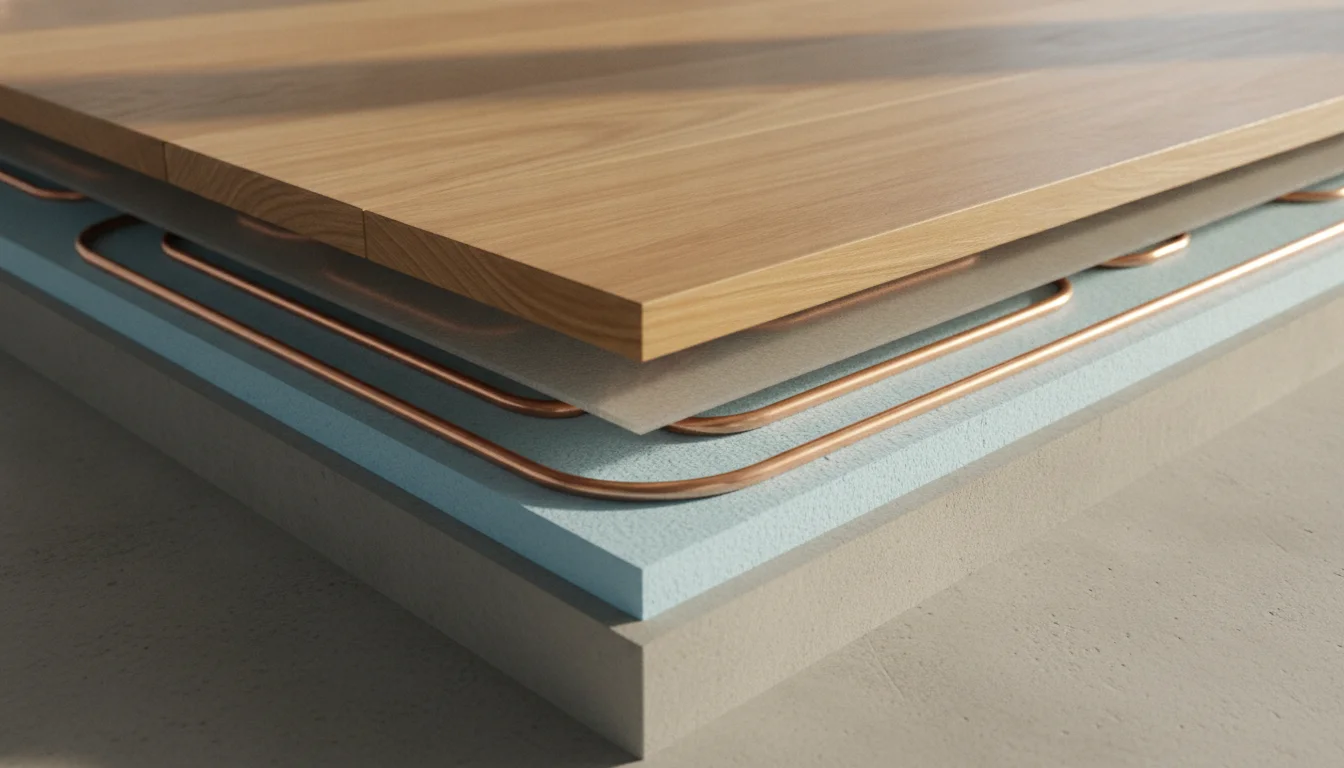
Most radiant floor leaks can be fixed without ripping out your whole floor. Here is the real tear-out risk, the cost, and how serviceable systems stay minimal.
Short answer: In many cases you do not have to tear up your entire floor to fix a radiant heating leak. A skilled technician can usually narrow a leak down to a small area, isolate it, and open only that section. Whether that is possible depends almost entirely on two things: how well the system was installed, and whether it was designed to be serviced. A full slab tear-out is the worst-case outcome of a poorly built or poorly accessible system, not an inevitable rule of in-floor heating.
That said, this is a fear worth taking seriously. The reason "radiant floor leak repair" is searched so often is that, done wrong, it really can mean demolishing finished stone, tile, or hardwood and the concrete beneath it. Below is an honest, answer-first walkthrough of what actually happens.
What causes radiant floor heating leaks?
Embedded radiant tubing does not fail randomly. When a leak appears, it almost always traces back to one of a few specific causes:
- Joint and connection failures. Field-made joints inside the slab are the single most common origin of pinhole leaks. Every connection buried in concrete is a potential weak point, especially where heat or workmanship created a defect.
- Material corrosion. Older in-floor systems sometimes failed because the tubing reacted with aggressive slab chemistry over the years. This is the source of the long-standing fear that metal tubing simply cannot survive inside concrete.
- Physical damage during construction. A misplaced fastener, drill, or saw cut after the slab is poured can nick a loop that was perfectly sound the day it was installed.
- Freeze damage or pressure events. In water-based systems, a freeze in an unprotected loop, or a pressure spike, can split tubing.
Notice the pattern: most of these are install-quality and material problems, not a flaw inherent to heating your floor. The honest takeaway is that any in-slab system lives or dies by how carefully it was built and what it was built from.
The dreaded tear-out: what does radiant leak repair actually cost?
Here is the scenario homeowners are afraid of. A conventional water-based loop springs a leak somewhere under a finished floor, the technician cannot pinpoint it precisely, and the only way to reach it is to remove the flooring above and chip out concrete to expose the tubing. In the worst cases, the recommended fix is to abandon the buried loop entirely and re-run new tubing across the whole area.
Cost figures vary widely and depend almost entirely on access and severity, so treat any number as a range rather than a quote. Industry sources typically report radiant repair costs running anywhere from a few hundred dollars for an easily reached fix to several thousand dollars when finished flooring and concrete have to be removed and tubing replaced. The expensive end is driven less by the repair itself and more by the demolition and restoration around it: lifting stone or hardwood, breaking and re-pouring slab, and re-finishing.
That is the real lesson. The leak is rarely the costly part. The tear-out is. So the right question to ask of any radiant system is not just "will it leak?" but "if it ever does, how big is the hole I have to open to fix it?"
How does a waterless DX system remove the water-leak class entirely?
A waterless direct-expansion (DX) radiant system changes the conversation because it does not circulate water through the floor at all. Instead of pumping heated water through tubing, it moves refrigerant directly through the in-floor network to deliver heating and cooling.
That single design choice eliminates an entire category of failure. With no water in the slab, there is:
- No water to leak into your subfloor, drywall, or the unit below.
- No risk of freeze-split loops in an unheated or power-out scenario.
- No water-side corrosion driven by oxygen and minerals circulating through the system year after year.
- No water damage cascade, where a small tubing leak quietly soaks structure for weeks before anyone notices.
This does not mean a refrigerant system can never need service. It means the specific, expensive, water-damage-plus-tear-out failure mode that people fear most is removed by design. You can read more about how the floor itself is built on our waterless radiant floor heating overview.
How is a refrigerant radiant system serviced without demolishing the floor?
Serviceability is something you engineer in before the slab is poured, not something you hope for afterward. Two features do most of the work.
Per-loop isolation valves. Each floor loop can be individually shut off at the manifold. If one zone ever needs attention, the rest of the home keeps running, and any repair is confined to a single, defined loop instead of the entire floor. This alone dramatically shrinks the area anyone needs to investigate.
A three-step leak-location method. Rather than guessing and opening a large area, a qualified technician works through a defined sequence to pinpoint the exact spot:
- Step 1 - Electronic detection. Sensitive electronic equipment listens for the acoustic signature of a refrigerant escape, narrowing the search to a region of the floor.
- Step 2 - Infrared imaging. A thermal camera reads temperature differences across the surface, highlighting the anomaly where the refrigerant behavior changes and tightening the location further.
- Step 3 - Nitrogen pressure-hold. The isolated loop is charged with dry nitrogen and monitored. A pressure drop confirms the leak and helps fix the precise point, so the technician opens only a small area instead of demolishing the room.
The combined result is repair that is minimally invasive: one isolated loop, one pinpointed location, one small opening.
The honest caveats
No system is maintenance-proof, and it would be dishonest to suggest otherwise. A few realities worth stating plainly:
- Install quality still matters more than anything. Any in-slab system, water or refrigerant, depends on correct pressure-testing of every joint before the floor is closed. Skilled installation is non-negotiable.
- Refrigerant repair is a job for a professional. Unlike a water loop, you cannot simply clamp a refrigerant line. Service requires a qualified HVAC technician, and the refrigerant must be properly recovered under EPA rules, never vented to the atmosphere.
- "Minimally invasive" is not "zero impact." Pinpointing a leak to a small area is realistic; promising you will never have to touch the floor is not. The goal is to make any repair a small, defined event rather than a demolition.
If you are weighing in-floor heating and the tear-out fear is what is holding you back, the right move is to choose a system designed to be serviced from the start. Explore how corrosion-protected copper, weld-free joints, isolation valves, and the three-step leak-location method come together on our anti-corrosion copper capillary system page.
Related reading
Frequently Asked Questions
Do you have to tear up the floor to fix radiant heat?
Not necessarily. With per-loop isolation valves and a precise leak-location method, a technician can usually narrow a leak to a small area and open only that section rather than the whole floor. A full tear-out is the worst case for a system that was hard to access or poorly installed, not a universal rule. The key is choosing a system designed to be serviced.
How much does radiant floor leak repair cost?
It varies widely and depends mostly on access and severity, so any figure is a range rather than a quote. Industry sources typically report anywhere from a few hundred dollars for an easily reached fix to several thousand dollars when finished flooring and concrete must be removed and tubing replaced. The expensive part is usually the demolition and restoration, not the repair itself.
Can a waterless radiant system still leak?
A waterless DX system carries refrigerant, not water, so it removes the water-leak class entirely: no water damage, no freeze-split loops, no water-side corrosion. It can still need service in rare cases, but the specific, costly water-damage-plus-tear-out failure people fear most is eliminated by design.
How do technicians find a leak inside a radiant floor?
On a refrigerant system, a qualified technician follows a three-step method: electronic detection to find the region, infrared imaging to read temperature anomalies and tighten the location, then a nitrogen pressure-hold to confirm the exact point. This lets the repair stay confined to a small opening instead of a full floor demolition.